



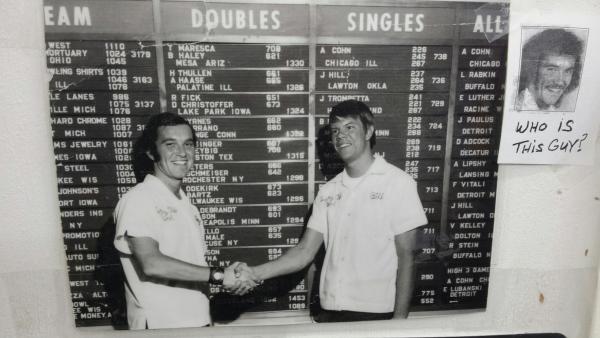
Pictured Above Are: Tony Maresca And Bill Haley, After They Won The 1971 ABC National Doubles Title In Detroit.
Finding Comfort By Going Into A Bowling Center As A Teenager, Helped Spring Board Tony Maresca's Success In Game.
His Accomplishments Include, Winning The Arizona State Master's Tournament At The Age Of 17.
Scottsdale - - - For those of us who have been involved in the game of bowling for a very long time, we remember the person who took us under his wing. For Anthony (Tony) Maresca, that person was a mechanic at Country Club Bowl, Bud Johnson.
Tony started bowling with the Cub Scouts at the age of eight, in Brooklyn, New York. After moving to Arizona when he was 12, he joined a league at the 32 lane Mesa Bowling Center. After bowling for a-year-and-a-half in the junior leagues, Tony's mother passed away and he stopped bowling for almost two years. When Tony bowled at Country Club Bowl the first night it opened, he rediscovered his interest in the sport. Tony found a second home at Country Club Bowl, and he was eventually hired to work at the center.
"Bud Johnson noticed I was struggling with coping with the passing of my mother. He helped me get my first job at the Bowl, and was the first to work with me on my game," said Tony, of his start in bowling. "After working my shift at Country Club, I would bowl for free, and that helped me develop a love and passion for the game."
Tony bowled and worked at Country Club throughout his high school and college years.
"The center along with Melrose Bowl in Phoenix, were the two action centers in the Valley," he remembers. "Bowling was huge back then. The city and state tournaments would go on for weeks. ACBA tournaments almost always had close to 100 competitors in most events.
40 years ago, all of the centers in the Valley still had wooden lanes. That was until the proprietors started to replace their wooden lanes for synthetic ones.
"Back then if you carried a 180 average, you were considered a pretty good bowler. Averaging 200 was very rare and only achieved by the elite bowlers. Wood lanes and the oil did not stay as consistent as today's synthetic lanes. Hard rubber and plastic balls were not nearly as powerful," Tony explained, of the difference of playing surfaces. "Some center proprietors were not as quick to resurface their lane surfaces, which would make the playing conditions much more difficult."
Tony's first major title was when he won the Arizona State Master's Tournament at the ripe old age of 17. He will always remember that tournament because there were close to 200 entries. He defeated another 17 year-old bowler, Paul Colwell of Tucson, in the semi-final match. As Arizona bowling veterans know, Paul went on to have a sensational career, and was inducted in both the PBA and USBC Hall of Fame. After his first title, Tony went on to win numerous city and state titles and ACBA events.
In 1971, he and Arizona Hall of Fame member, Bill Haley from Prescott. Won the ABC National Doubles Title in Detroit, Michigan. In that event, Tony's 708 series was the highest doubles score ever recorded by a left-hander up until that time. Tony continued bowling through college, and graduated from Arizona State University in 1974. He declined a job offer, and instead, he joined the PBA National Tour.
"I thought I owed it to myself after financing my college through bowling, to give the tour a try," Tony explained.
Tony struggled his first four tour stops, thus never finishing high enough to cash.
"My last tournament was in Houston, TX. I was about ready to come home, because I was out of my own money. Even though I had picked up a sponsor for the remaining summer tournaments," he said. "I was still thinking I had had enough."
However, fate intervened.
"It just so happened in the Houston event, I was crossing with a fellow by the name of Earl Anthony. After the Houston event, the tour had a week off. The next event was in Connecticut," Tony said, of the intervention. "He asked me if I was going to make the East Coast swing that consisted of five more events. I told him I had a sponsor, but was still thinking about going home. I was married right before I left for the tour, and was really missing my wife, Linda."
Earl had explained to Tony that the lanes back East, in most cases, had more friction and he thought that would be better for my game.
"And, I've always said that friction is my friend," he said, with a laugh.
Tony then experienced a lot more success on the East Coast. After a week of travel, the first event was in Hartford, and Tony made the finals by finishing 23rd. He cashed in three of the four events he bowled, including a top 10 finish in Waukegan, Illinois. Tony stayed on the tour for a little over 18 months. His greatest success was making the televised finals in Garden City Long Island, New York, where he finished fourth.
After returning home from the tour, Tony became the Head Bowling Coach and Assistant Recreation Center Manager at Arizona State University
"I really enjoyed my nearly eight years of coaching. We had a lot of success," says Tony. "Six of the eight years, our teams qualified for nationals."
In 1981, Tony coached the Sun Devils men's team to a victory at the national championships. Tony also helped Women's Head Coach Terry Nenaber lead the women to the national title that year as well. In 1982, the ASU Men's team finished third, and in 1983, they finished second.
"I have stayed in touch with a number of the bowlers on these teams throughout the years," he says, of his tenure at ASU. "One person in particular, who I have had the pleasure to bowl with and sometimes, but not the pleasure of bowling against, is Warren Eales."
Recalling his bowling career at ASU, Arizona Hall of Famer Warren Eales remembers: "Ironically, we were not ranked number one the year we won, but our team was ranked number one in 1979 and 1982. Tony drills all of my equipment at his pro shop. He has continued to coach me for the last 30 years."
While at ASU on two different occasions, Tony was hired by the United States Sports Academy to teach bowling in Saudi Arabia and Bahrain.
"What an education," he said. "And an eye opening experience that was."
Tony left full-time coaching at ASU to pursue a business career. He opened a pro shop in North Phoenix during the 1985-86 season, and has been in the business since that time. He now owns just one pro shop, AA Action Bowling Supply inside of Brunswick Via Linda Lanes in Scottsdale. Having been involved in all aspects of the sport, Tony knows how bowling has dramatically changed over the past 40 years.
From wood lanes where accuracy was key, to today's synthetic lanes where its all about power and revolutions, one thing has stayed the same.
"Talent is talent," said Tony. "On tougher lane conditions, it has always been the top bowlers who are able to repeat shots and make proper adjustments as the lane conditions change. Whether it be 20, 30, 40 years ago or today, those will be the ones who come out on top."
Tony has shown his talent over his career with about 25 ACBA titles, and numerous city and state titles. He also won a Bowler's Journal doubles title in the mid-1970s. He is a member of the Mesa, Phoenix, and Arizona State Bowlers' Hall of Fames. He was the youngest member elected to the Arizona Bowling Hall of Fame in 1980, at the age of 30.
Even after spending his professional life in the game, he still enjoys the challenge of competing at a high level. Tony still regularly bowls in many tournaments. He particularly enjoys bowling in Mega-buck tournaments as well as the Senior and Super Senior National Master's Tournaments.
"As long as I am competitive, I find it a big advantage owning a pro-shop. It allows me to try new equipment, keep up on the latest trends, and attend informational seminars," he says, of owning a pro-shop. "However, if the right offer came along, I would be interested in cutting back my work at the pro-shop, especially since I will soon be a grandpa for the first time."
While he has bowled many 300 games and numerous 800 series, he still wants to roll one more 300 game.
"I have a tradition of giving my 300 rings to family members, including my poodle, Fannie," he says. "I have to bowl at least one more, so I can give the ring to my soon to be born granddaughter."
This year will mark Tony's 47th appearance at the USBC Nationals. Even though he would certainly welcome another Eagle, his main goal is to reach 100,000 pins at the National Tournament, a feat only accomplished about 15 times.
"I have 83,414 now, and if I can stay healthy," he said. "Long enough for about 10 to 11 years, I should be able to reach that goal."
In the meantime, Tony still enjoys bowling in leagues and tournaments. He especially finds helping novice and veteran bowlers very rewarding.
"Although I think having modern equipment is essential for today's different lane conditions, nothing tops hard work," he said. "If you don't put in the time to better yourself, all the bowling balls in your bag are not going to make a big difference."
Clearly, Tony is an Arizona bowler who has put in a lifetime of work and experienced great success in all aspects of the game.
Arizona State Bowling News May 14, 2017